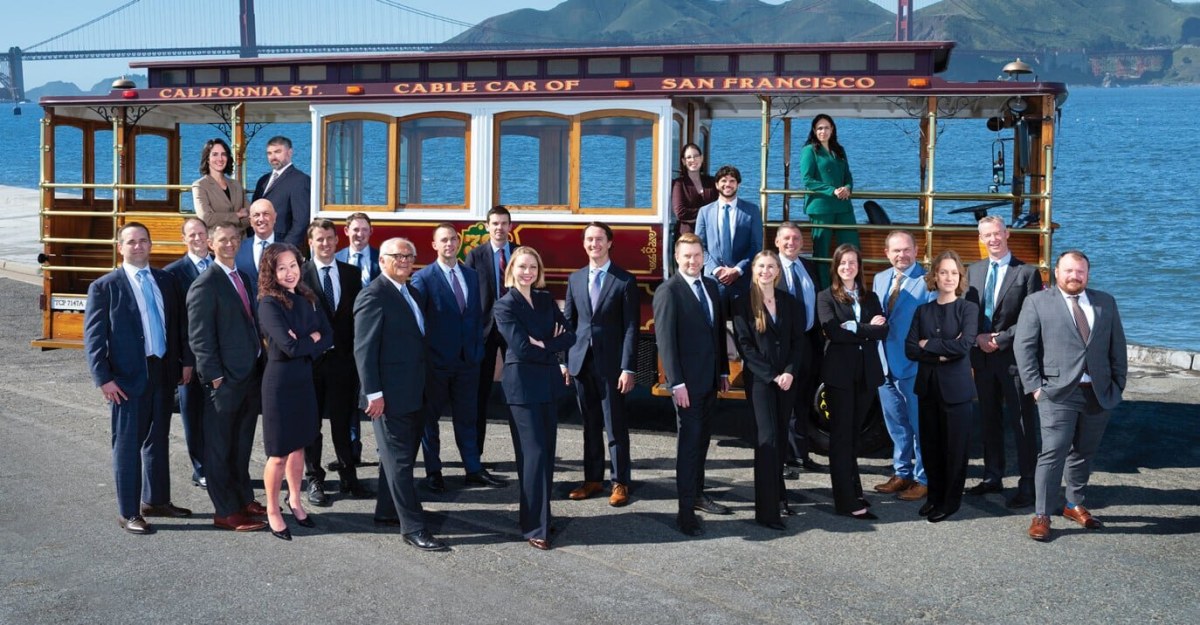
VerifiedLawFirms editorial: History and reach since 1959 — Bruce Walkup founded the firm in 1959. It is based in San Francisco and represents injured people in the Bay Area and across California.
Each row is a check on this listing. Document checks are reviewed by an editor from evidence the firm submitted and are dated by that review; automatic checks confirm the listing's contact details are present and correctly formatted. Verification is independent of membership tier.
What we verified
How we verified
Status
Last checked
AddressThe listed street address resolves to a real location on the map.
Automatically
Confirmed
2026-07-28
Phone numberA phone number in valid US format is listed for this firm.
Automatically
Confirmed
2026-07-28
Automatic checks confirm the listing's contact details are present and correctly formatted. They do not verify the firm's licensure or standing — those are the document checks an editor reviews. How we verify →
About Walkup, Melodia, Kelly & Schoenberger
Walkup, Melodia, Kelly & Schoenberger is a personal injury law firm based in San Francisco, California. Bruce Walkup founded the firm in 1959, and its attorneys have represented injured people in state and federal courts, arbitration hearing boards, mediations, and settlement conferences since then.
The main office is at 650 California Street, 26th Floor, in San Francisco. The firm handles car, truck, bicycle, pedestrian, and rideshare accident cases, along with medical malpractice, birth injuries, Kaiser Permanente claims, brain and spinal injuries, wrongful death, and defective product claims.
It also takes on class actions and mass tort litigation, including multi-district cases venued outside California, and represents clients in elder abuse, obstetrical negligence, and insurance matters. The firm works on a contingency fee basis and charges no upfront fees.
The practice is made up of shareholders, associate attorneys, and of-counsel lawyers. Firm members have taught trial advocacy for the National Institute of Trial Advocacy and at several California law schools. The firm serves clients in the San Francisco Bay Area and across California, and has handled cases in other states.
Editor's Review
VerifiedLawFirms editorial
History and reach since 1959
Bruce Walkup founded the firm in 1959. It is based in San Francisco and represents injured people in the Bay Area and across California. The website also states that its lawyers have handled matters in other states.
The firm's history includes work in state and federal courts. Its attorneys have also represented clients before arbitration hearing boards, in mediation, and at settlement conferences. These settings cover both formal litigation and structured efforts to resolve claims.
The stated practice has a clear personal injury identity. Its work covers individual accident claims, medical injury cases, product claims, wrongful death, and larger proceedings that involve groups of claimants. In my opinion, that mix gives potential clients a useful picture of the kinds of disputes the firm accepts.
Focus and practice areas
The website identifies claims tied to traffic crashes, medical care, unsafe products, property conditions, and severe injury. It lists car, truck, motorcycle, bicycle, pedestrian, and rideshare accidents. It also names premises accidents, catastrophic injuries, and insurance matters.
Road and transportation claims
Each type of road case can raise a different set of facts. Car and truck claims may involve driver conduct, vehicle records, police reports, witness accounts, photographs, and medical records. Truck matters may also require records held by a carrier or another business connected with the vehicle.
Bicycle and pedestrian cases often require close study of the collision site, traffic controls, visibility, and the movements of each person involved. Rideshare claims can add questions about app status and available insurance at the time of a crash. Motorcycle claims may require similar proof about road conditions, vehicle movement, protective equipment, and the nature of the injuries.
These cases usually develop through evidence gathered soon after the event and medical material created during treatment. The parties may dispute fault, causation, or the value of the claimed harm. Courts and insurers look at the documents, testimony, and applicable law when assessing those disputes.
Medical negligence and birth injury
The firm's medical work includes medical malpractice, Kaiser Permanente malpractice claims, obstetrical negligence, and birth injuries. These categories can involve hospitals, physicians, health systems, and other care providers. The website groups them within the firm's injury practice.
Medical malpractice claims commonly turn on treatment records, clinical decisions, the standard of care, causation, and the patient's condition. Lawyers often build a medical timeline and obtain opinions from qualified clinicians. The evidence must connect the alleged error with the injury claimed in the case.
Obstetrical and birth injury matters can require records created during pregnancy, labor, delivery, and newborn care. Fetal monitoring material, medication records, operative notes, and later medical assessments may become part of the inquiry. These cases can involve both the circumstances of delivery and the child's later needs.
Brain, spinal, and fatal injuries
The website names brain and spinal injuries, catastrophic injury, and wrongful death among the firm's areas of work. These claims may arise through traffic collisions, unsafe products, medical care, or incidents on property. The source of the injury shapes the liability questions.
Brain injury evidence may include scans, neurological findings, cognitive testing, treatment notes, and accounts of changes in daily life. Spinal injury claims may involve surgery, rehabilitation, mobility limits, and future care. General damages analysis can also consider employment records and the effect of an injury on ordinary activities.
Wrongful death cases address a fatal event and the losses claimed by eligible family members under the governing law. The underlying liability issue still requires proof. Medical records, incident evidence, financial documents, and testimony can all have a role in that process.
Product, property, and group litigation
Defective product claims add questions about the product itself and the businesses involved in making or distributing it. Preservation of the item can matter because later inspection may address design, manufacturing, instructions, warnings, and possible changes after sale. Manuals, photographs, purchase records, and technical material may also inform the claim.
Premises accident work concerns injuries connected with property conditions. General issues can include control of the property, notice of a condition, inspection practices, maintenance records, photographs, and witness accounts. The precise duty depends on the facts and the law that applies.
The firm also identifies elder abuse and insurance matters. Elder abuse cases can involve care records, facility documents, witness testimony, financial material, and the duties imposed by law. Insurance disputes can turn on policy language, claim communications, coverage positions, and the handling of the underlying loss.
Class actions, mass torts, and multi-district cases
The website states that the firm takes class actions, mass tort litigation, and multi-district litigation. These forms of litigation address claims that share some factual or legal issues, though each has its own procedure. They can involve many claimants and substantial document review.
In a proposed class action, a court examines whether the named plaintiffs may pursue claims for a defined group. Mass tort proceedings may coordinate related injury claims while preserving facts that differ among individual claimants. Multi-district litigation allows federal courts to transfer related cases to one court for coordinated pretrial work.
The firm says it has worked on multi-district matters venued outside California. That experience places part of its stated work beyond ordinary single-plaintiff litigation in one local court. The website makes no case result the basis of this description, so the useful fact is the type and geographic scope of the proceedings identified.
How the cases may proceed
The firm's stated forums include court proceedings, arbitration hearing boards, mediation, and settlement conferences. A single dispute may pass through several of these settings. The proper route depends on the claim, the parties, any controlling agreement, and the rules of the forum.
Investigation and filing
Personal injury work commonly begins with fact gathering and review of the applicable time limits. Lawyers may obtain incident reports, photographs, medical records, witness information, employment material, and insurance documents. Product and medical cases often require added technical or clinical review.
If the parties do not resolve the matter during the claim stage, a claimant may file a complaint in an appropriate court or begin an agreed arbitration process. The responding parties can challenge liability, causation, damages, or procedure. Pleadings define the claims and defenses that the forum will address.
Discovery, mediation, and trial preparation
During discovery, each side may request documents, submit written questions, and take sworn testimony. Courts manage deadlines and decide disputes about what the parties must provide. Medical examinations, site inspections, or product testing may arise when the facts call for them.
Mediation places a neutral mediator between the parties for settlement talks. A settlement conference may involve a judge or another assigned neutral, depending on the forum. Neither process decides the case unless the parties reach an agreement.
When a matter continues toward trial or an arbitration hearing, the parties organize exhibits, prepare witnesses, address motions, and present their positions. The judge, jury, or arbitration panel then applies the governing rules to the admitted evidence. The firm's website states that its attorneys have represented injured people in each of these kinds of settings.
How the team is built
The website assigns defined titles across the lawyer roster. It describes a structure made up of shareholders, associate attorneys, and of-counsel lawyers. Those titles give readers a basic view of how the legal team is organized.
Shareholders and senior trial counsel
The site names Michael A. Kelly, Matthew D. Davis, Douglas S. Saeltzer, Khaldoun A. Baghdadi, and Doris Cheng as shareholders. It gives the same title to Spencer J. Pahlke, Sara M. Peters, Conor M. Kelly, Andrew P. McDevitt, and Valerie N. Rose. The roster identifies Richard H. Schoenberger as senior trial counsel.
These names show that the firm's stated ownership group includes several lawyers. The title of senior trial counsel also identifies a distinct trial role within the roster. The website does not tie particular practice areas to each person in the material supplied here, so the titles and names are the supported points.
Associates and legal teaching
Jeffrey A. Clause appears on the website as an associate attorney. The firm also says that members have taught trial advocacy for the National Institute of Trial Advocacy and at several California law schools. That teaching activity relates directly to courtroom skills, though the website text provided here does not assign it to specific named lawyers.
As a reviewer, the useful feature of this roster is its direct identification of lawyers and their roles. The team structure also matches the firm's stated range of individual claims and group litigation. The available facts support a firm with a long operating history and a defined concentration in injury law.
The identity supported by the record
Walkup, Melodia, Kelly & Schoenberger presents a focused list of injury matters and the forums in which its lawyers have worked. The practice includes transportation accidents, medical negligence, severe injury, wrongful death, product claims, elder abuse, insurance disputes, and group litigation. Each category appears on the firm's own pages.
The firm's history begins with Bruce Walkup's founding in 1959. Its named roster includes shareholders, senior trial counsel, an associate attorney, and an of-counsel component described by the firm. The website states that the firm serves the San Francisco Bay Area and California and has handled cases in other states.
Client reviews
No client reviews yet.
Be the first to leave a review.
Write a review
Reviews are from clients of the firm. We email you a link to confirm, then an editor checks your review before it appears. Your email stays private.
Amalie YachAssociate Attorney
Andrew P. McDevittShareholder
Ashcon MinoiefarAssociate Attorney
Christian R. JaguschMedical Negligence Counsel
Christian R. Jagusch holds both an MD and a JD and works at Walkup, Melodia, Kelly & Schoenberger in San Francisco. He earned a Bachelor of Science in Chemistry from Creighton University and attended the Creighton University School of Medicine in Omaha, Nebraska, then completed postgraduate training at the Los Angeles County and University of Southern California Emergency Medicine Residency Program. He practiced Emergency Medicine for more than 10 years and remains a Board Certified Emergency Medicine Specialist. His practice focuses on medical malpractice, personal injury, and product liability litigation for plaintiffs.
Clifton N. SmootAssociate Attorney
CMConor M. KellyShareholder
Conor M. Kelly is an attorney at Walkup, Melodia, Kelly & Schoenberger in San Francisco, California. He handles complex personal injury and wrongful death cases, including matters involving traumatic brain injury, spinal cord injury, and catastrophic orthopedic injuries. He has represented clients in cases involving dangerous products, premises liability, vehicle negligence, workplace injuries, and medical malpractice. He earned his J.D. from the University of California Hastings College of the Law, where he has served as an adjunct professor, and he completed undergraduate studies at Cornell University.
Doris ChengShareholder
Douglas S. SaeltzerShareholder
Elise GorbergAssociate Attorney
IAIan A. HeadAssociate Attorney
Jeffrey A. ClauseAssociate Attorney
Jeffrey A. Clause is an attorney at Walkup, Melodia, Kelly & Schoenberger in San Francisco, California. He handles personal injury litigation and product liability litigation on behalf of plaintiffs.
Joseph NicholsonAssociate Attorney
Joseph Nicholson is an attorney with Walkup, Melodia, Kelly & Schoenberger in San Francisco, California. His practice covers personal injury litigation and product liability litigation on behalf of plaintiffs.
Katherine ConnollyAssociate Attorney
Kelly L. GanciAssociate Attorney
Kevin L. DomecusOf-Counsel
Khaldoun A. BaghdadiShareholder
Martin NeiraAssociate Attorney
Matthew D. DavisShareholder
Max SchuverSenior Mass Torts Counsel
Max Schuver is an attorney at Walkup, Melodia, Kelly & Schoenberger in San Francisco, California. He earned his J.D. from the University of California Hastings College of the Law in 2010. His practice focuses on personal injury litigation and product liability litigation on behalf of plaintiffs. He has been recognized by Best Lawyers in the Ones to Watch category since 2024.
MAMichael A. KellyShareholder
Owen P. StephensMass Torts Counsel
RHRichard H. SchoenbergerSenior Trial Counsel
Sara M. PetersShareholder
Spencer J. PahlkeShareholder
Tina GlezakosOf-Counsel
Valerie N. RoseShareholder
Contact Walkup, Melodia, Kelly & Schoenberger
Reach this firm directly using the details below. VerifiedLawFirms is a directory, not a referral service, so you contact the firm yourself and we never sit in between.